


Email Marketing
Published:
Email Marketing
Qasim Farooq
Share

Need a faster way to get verified B2B emails without blowing the budget? In 2025, Apollo.io promises to be that shortcut.
The newest version of its Email Finder touts a 265-million-contact details database, smarter AI filters, and intent signals that spotlight prospects who might already have their wallets open.
But are the improvements enough to offset past complaints about bounce rates and clunky UX?
In this blog we'll breakdown what's new with Apollo, sift through user-reported pros and cons, and weigh whether Apollo’s upgrades are worth your time in 2025.
What Is New In Apollo Email Finder
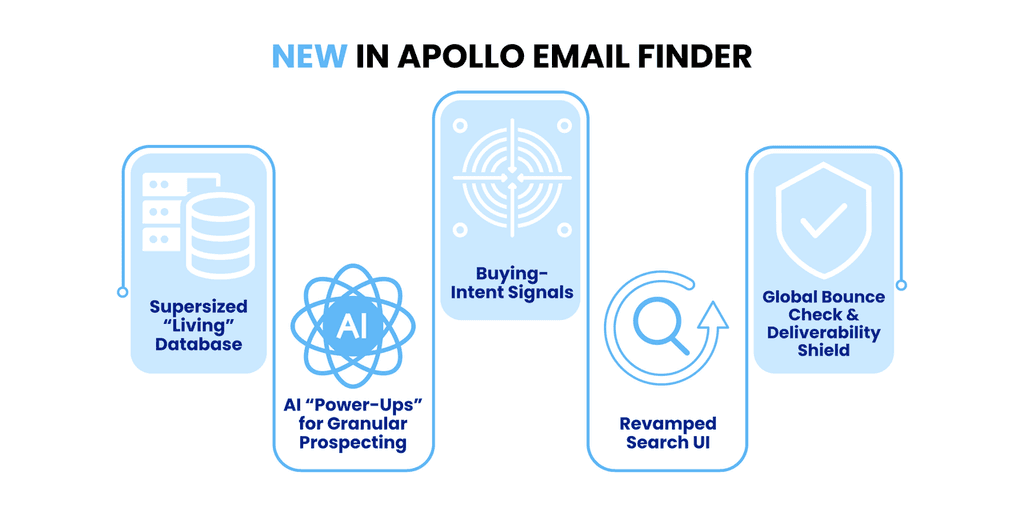
Supersized “Living” Database
Apollo’s contact universe now exceeds 200–265 million B2B records of fresh data, updated continuously by web crawlers, user contributions and third-party feeds.
Each new record runs through enrichment and verification pipelines, giving marketers phone numbers and firmographics in a single pull.
AI “Power-Ups” for Granular Prospecting
Launched late 2024, AI Power-Ups let you layer advanced logic onto searches.
These filters study historical intent, tech-stack clues, and engagement signals, spitting out ultra-targeted lists in seconds.
Buying-Intent Signals
Apollo now blends in third-party intent data, flagging companies actively researching topics relevant to your offer.
Instead of cold blasts, you can focus on accounts that are statistically “in-market”.
Revamped Search UI
The core search dashboard got a facelift: cleaner layouts, faster filtering, bulk-save views, plus a dark-mode toggle for late-night list-building.
Combined with the Chrome extension’s one-click email capture on LinkedIn and company websites, it streamlines day-to-day prospecting.
Global Bounce Check & Deliverability Shield
A headline update inside Sequences: Apollo automatically pauses any email scheduled to an address flagged “Likely to Bounce.”
The system surfaces risky contact details before send, letting you swap or skip them - crucial for keeping contact data relevant and domain reputation intact.
In short, Apollo’s Email Finder in 2025 is more powerful than before. The contact database is larger, and new features like AI filters and intent data help marketers zero in on the right prospects faster.
Next, let’s analyze how these changes are playing out for users – what’s better, what’s not – through the lens of real reviews.
Apollo Pricing (2025)
Apollo’s paid plans come in three tiers – Basic, Professional, and Organization – in addition to the free plan. All plans, even the free tier, include unlimited email credits for email lookups.
Pricing is typically per user, and if paid annually it works out roughly as follows:
Free – $0, includes limited credits (approx 1,200 contact info lookups/year plus a handful of phone reveals). Good for trying out Apollo’s Email Finder on a small scale.
Basic – ~$49 per user/month (annual billing) for significantly higher limits (up to ~60,000 contacts/year), plus essential features and integrations. (Month-to-month pricing is around $59/user).
Professional – ~$79 per user/month (annual) for ~120,000 contacts/year and more advanced features (unlimited email sequences, automation workflows, etc.)
Organization – ~$119 per user/month (annual, 3 user minimum) for ~180,000 contacts/year and the full feature set (advanced security, team collaboration tools, etc.)
Analysis: Pros and Cons
What Users Like About Apollo
What Users Love | Why It Matters |
Enormous Contact Database | Reviewers on G2 rave that Apollo “finds emails for virtually any industry.” That breadth lets lean teams skip multiple tools and keep list-building under one roof. |
Advanced, AI-Driven Filters | Marketers cite the new AI Power-Ups as a “game-changer,” enabling micro-segmentation (title, tech stack, funding events, firmographics) without spreadsheet gymnastics. |
Workflow Integration & Chrome Extension | Sales reps appreciate exporting leads straight into Apollo sequences or their CRM. The chrome web store extension autofills emails while scrolling LinkedIn profiles - no copy-paste circus. |
Quick Product Iteration | Frequent rollouts - AI search, dark mode, intent data - show Apollo listens to feedback and iterates fast, keeping users on modern rails without extra add-ons. |
What Users Find Lacking In Apollo
Pain Point | How Users Describe It |
Data Accuracy Variability | Multiple G2 and Reddit posts note 70–80 % accuracy of email data at best, with “Verified” email addresses still bouncing. Many users run a secondary verification pass to avoid penalties due to lack of accurate data. |
Higher-than-Ideal Bounce Rates | A vocal Reddit thread reported 50 % bounce on a raw export. Extreme, but even moderate bounce (15-20 %) can dent deliverability without scrubbing. |
Feature Bloat & Learning Curve | Newcomers call the UI “overwhelming” - a spaceship for simple lookup tasks. It takes time to master filters, sequences, and credit rules. |
Lag & Occasional Glitches | Heavy exports sometimes stall; the Apollo Chrome extension can freeze with large queues. Support tickets get answered, but not always promptly. |
Shrinking Free-Tier Allotment | Long-time users lament that the free plan dropped to ~100 credits/month, forcing power users onto paid tiers sooner than before. |
Bonus Read: Apollo Alternatives That Actually Scale With You
Conclusion
Apollo’s Email Finder is bigger, smarter, and more automated than ever. AI-powered searches and intent signals help pinpoint warm prospects, while generous credit caps keep costs predictable.
Yet the age-old caveat still applies: quantity doesn’t always equal quality.
If you're looking for an AI-powered email marketing platform that puts accurate AI agents driven data enrichment, advanced hyper-personalization and superior deliverability at the forefront, GoCustomer might just be the ideal match for you.

From pulling real-time buyer data for email templates to sending perfectly timed, deliverability-friendly emails, the platform handles every step of outbound for you.
In the end, it all depends on what you and your business needs. f you can stomach a bounce scrub and don’t mind a nuanced UI, Apollo offers enormous bang for the buck in 2025. Otherwise, there's a better alternative available.
Happy Marketing!

Reach more customers with your cold emails
Table of Contents
In a nutshell
Apollo offers a free plan that includes limited access to its Email Finder. As of 2025, users on the free tier can expect up to approximately 1,200 contact lookup credits per year, which translates to around 100 contacts per month. However, this plan has certain limitations, including restricted phone number access and export limits. Power users or teams working at scale will likely need to upgrade to a paid plan to unlock more contacts and advanced features.
Email accuracy is one of the most discussed topics among Apollo users. While Apollo claims high verification standards and employs global bounce checks to improve deliverability, user feedback from platforms like Reddit and G2 suggests that email accuracy typically hovers around 70–80%. Some users report that even emails marked “verified” can bounce. For best results, many professionals recommend using a third-party email verifier before launching outreach campaigns.
Yes, Apollo integrates well with several major CRM and outreach platforms. Users can directly export found leads to tools like Salesforce, HubSpot, and Apollo’s own sequencer. The Chrome extension also allows for seamless email capture from LinkedIn and websites, further streamlining workflows. This integration makes Apollo a useful tool not just for finding emails, but for managing entire prospecting and engagement pipelines.
Apollo is particularly valuable for small to medium-sized marketing and sales teams that need to generate large volumes of leads without breaking the bank. Startups and agencies often turn to Apollo for its affordability, while more established sales teams appreciate the powerful filtering and intent data features. Companies that have internal processes to verify emails or scrub lists before outreach will benefit most, as they can take full advantage of Apollo’s scale while mitigating data accuracy risks.
Yes, Apollo has introduced several new features in 2025 that make it a more powerful and user-friendly platform. These include AI-assisted search filters, intent data integration, a redesigned search UI, and stronger bounce protection. Users generally agree that the tool is evolving in the right direction, though data accuracy and platform complexity remain areas that need continued attention.

Subscribe to our Newsletter!
Digital advice costs money but we send it to
your inbox for free.
Related Blogs


Time is Money, and We're About to Save You Both!
Book a quick demo of our email marketing tools and watch as we transform your leads into loyal customers.

![A loop illustration w-auto h-[70px]](/_next/image?url=%2F_next%2Fstatic%2Fmedia%2Fvector1.7738e6de.png&w=256&q=75 "GoCustomer Platform Image")

Get in touch
Subscribe to our weekly Newsletter and receive updates via email.