

Email Marketing
Published:
Email Marketing
Qasim Farooq
Share
You know that sinking feeling when you hit "send" on an email, and… nothing? No clicks, no opens, just radio silence. It’s like shouting into the void. If your email list has gone cold, don’t stress—you’re not the only one dealing with this.
It happens to the best of us.
But here’s the thing: getting your audience back doesn’t have to be complicated. Take a brand like H&M—they sent out a “We Miss You” email with a little discount and some charm, and boom, customers came back. Easy, right?
And it’s not just about feeling good when people re-engage—it’s about the numbers. Re-engagement campaigns can boost customer retention by 45% and deliver one of the highest ROIs in email marketing.
If you’re not sending re engagement emails, you’re leaving cash on the table.
So, how do you make it happen?
In this post, I’ll show you re-engagement emails examples and strategies that actually worked. From clever subject lines to offers people can’t resist, you’ll get ideas you can steal (or “borrow”) to wake up your email list and get those clicks rolling in again.
Sound good? Let’s get started!
What Exactly Are Re-Engagement Emails?
Let’s keep it simple: re-engagement emails are your way of saying, “Hey, remember me?” to your audience. These are the emails you send when subscribers stop interacting—no clicks, no opens, nothing.
They’re like a wake-up call, but with a friendly tone (and maybe a great offer).
The goal? To remind people why they joined your list in the first place and show them why sticking around is worth it. Whether it’s a little nudge, a clever incentive, or just a “We miss you,” re-engagement emails are all about reigniting that connection.
Different Types of Re-Engagement Emails
Not all re-engagement emails are created equal. Depending on what you’re trying to achieve—or why your audience went quiet—there are a bunch of approaches you can try.
Let’s break them down:
Reconnecting with Cold Leads
Cold email re-engagement campaigns are your chance to breathe new life into inactive subscribers who’ve stopped engaging.
The key? Rekindle their interest by revisiting their preferences or sharing updates they might have missed. Highlight new features, products, or services that align with their original interests.
An effective re-engagement email campaign should deliver something meaningful, like exclusive content, a discount, or personalized recommendations.
Focus on creating a re-engagement email sequence that feels valuable, not intrusive. For instance, remind them why they signed up, address common objections, and offer a compelling reason to reconnect. Done right, these re-engagement emails can turn cold contacts into active subscribers again.
Winning Back Lost Customers
Lost customers aren’t truly lost—they’re just waiting for the right nudge. A win-back email is your chance to remind them why they loved your brand.
Start by understanding why they disengaged. Was it a lack of communication, unmet expectations, or a better offer elsewhere? Address these pain points head-on with a successful re-engagement campaign.
Structure your email to highlight past interactions and offer renewed value. Include elements like a limited-time coupon code, a friendly reminder of what they’re missing, or even a “we miss you” message.
Combine this with an engaging email subject line to make sure they open the email. These strategies can help re-engage inactive customers and bring them back into the fold.
Price Drops and Back-in-Stock Alerts
Everyone loves a good deal, which is why price drop and back-in-stock emails are perfect for reconnecting with dormant email subscribers.
These emails work because they tap into psychological triggers like urgency, scarcity, and exclusivity.
To make these re-engagement emails stand out, focus on timing.
Send a reminder email as soon as the price drops or stock is replenished, and include a clear call to action like “Get it before it’s gone!” Highlight how the product aligns with their preferences or previous browsing behavior to create a stronger connection.
These are excellent examples of re-engagement email campaign content that drives results.
Celebrating Anniversaries and Milestones
Anniversaries and milestones are a fantastic opportunity to re-engage your audience with a personal touch. Whether it’s a subscriber’s anniversary or a milestone in their journey with your brand, these re-engagement emails help build emotional loyalty and strengthen relationships.
Celebrate with small gestures like a thank-you note, a free resource, or a limited-time offer.
For example, “Happy one-year anniversary! Here’s a 20% discount to celebrate.”
These emails don’t just drive clicks—they foster goodwill and encourage customer retention. Use this as part of your email marketing strategy to keep subscribers connected and engaged.
Gentle Reminder Emails
Sometimes, people just need a nudge. A gentle reminder email is perfect for inactive subscribers or those who’ve left something unfinished, like an abandoned cart or an unread offer.
Keep the tone friendly and approachable. For example, “Hey, we noticed you left something in your cart—let’s make sure you don’t miss out!” Use a subtle sense of urgency and ensure your email subject line grabs attention without being pushy.
Reminder emails are a core part of an engagement email campaign, helping you re-engage inactive users and guide them back into the fold.
Re-Engagement Email Templates That Work
Cold Lead Reconnection Template
Subject Line: Hey {{first name}}, can we pick up where we left off?
Hey {{first name}},
I hope everything’s going great for you in {{city}}! It’s been a while since we talked about {{service}}, and I wanted to circle back with some exciting updates.
We’ve recently launched {{new feature}}, and I genuinely think it’s a game-changer. Here’s what it can do:
-> {{Benefit 1}}
-> {{Benefit 2}}
-> {{Benefit 3}}From what I remember about {{prospect’s company}}, this could really help address {{pain point}}. I’d love to offer you an exclusive deal to get started—just as a way to show how much I value our earlier conversations.
Let me know if you’d like to chat or see a demo. I’m here to help make this process as smooth as possible for you!
Looking forward to catching up,
{{your name}}
Pro Tips:
Personalize the email based on previous interactions—mention their city, past discussions, or specific challenges. This makes it feel like you’re speaking directly to them, not just sending a canned email.
I’ve found that keeping the tone friendly and collaborative works wonders. You don’t want to sound like you’re hard-selling; it’s about opening the door for a conversation.
Always end with a clear action step. When I include a link to schedule a call or explore an offer, I see much higher responses.
Win-Back Email Template
Subject Line: We miss you, {{first name}}—let’s reconnect!
Hey {{first name}},
I noticed we haven’t heard from you in a while, and honestly, we miss having you as part of the {{brand}} community! So much has changed since you were last with us, and I’d love to catch you up on what’s new.
Here’s what we’ve been working on:
-> {{Benefit 1}}
-> {{Benefit 2}}
-> {{Benefit 3}}To make it easier for you to dive back in, I’d like to offer you {{discount}} on {{product}}—think of it as our “welcome back” gift. You can click the link below to claim it:
[{{CTA Link}}]
I’d love to hear what’s been going on with {{prospect’s company}} and see how we can support your goals again. Let’s reconnect!
Cheers,
{{your name}}
Pro Tips:
Be genuine. Whenever I make these re-engagement emails feel like a heartfelt gesture rather than a sales pitch, I notice more replies and engagement. Use language like “we miss you” to evoke a sense of connection.
Include something special, like a discount or perk, that makes them feel valued. From my experience, time-limited offers tend to perform better because they encourage immediate action.
Don’t forget to make it personal. When I reference something specific to the recipient, like their past purchases or interactions, the email feels less generic and more like a conversation.
Friendly Reminder Template
Subject Line: {{First name}}, just wanted to check in on {{topic}}
Hey {{first name}},
I hope your week’s going well! I wanted to quickly check in and see if you’ve had the chance to explore {{unique selling proposition}}.
No rush at all—I just didn’t want you to miss out if this could be helpful for {{prospect’s company}}. I know how busy things can get, so here’s a quick link to check it out:
[{{CTA Link}}]
Let me know if there’s anything I can do to make things easier for you or if you have any questions. I’m here to help!
Looking forward to hearing from you,
{{your name}}
Pro Tips:
Keep it short and sweet. Whenever I write emails like this, I stick to one or two key points—it’s enough to nudge the reader without overwhelming them.
Use a friendly tone. From my experience, when I write like I’m talking to a colleague or friend, the response rate goes up. Avoid being pushy; the goal is to gently remind, not demand.
Always make the next step simple. A link to click or a single action they can take right away tends to work best for me—no one likes complicated instructions in an email.
Inspiring Re-Engagement Email Examples
Dinnerly: Straightforward and Incentive-Driven
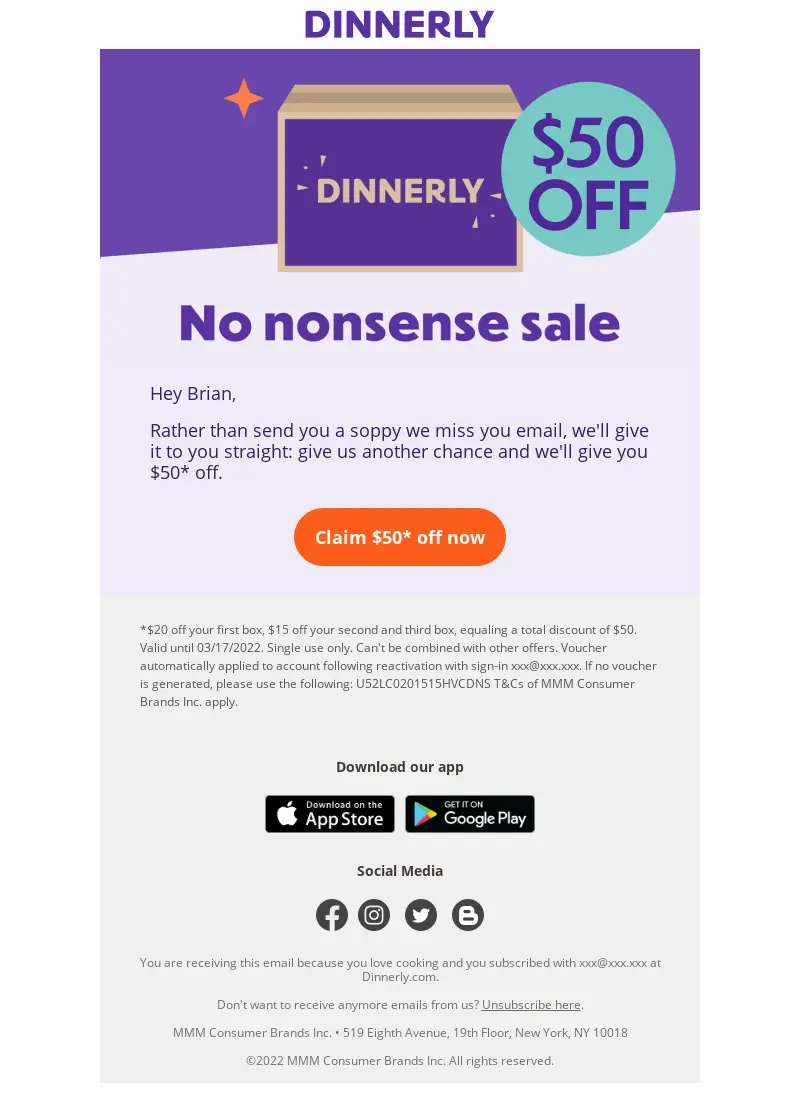
I love how Dinnerly keeps it simple. Instead of overdoing the “we miss you” sentiment, they take a direct approach with a clear benefit—$50 off. It’s refreshing because it respects the reader’s time.
If there’s one thing I’ve learned about re-engagement campaigns, it’s this: people respond to value, not fluff. So, if you’re sending a re-engagement email, make your message direct and focus on what’s in it for the reader.
Here’s a tip that’s worked for me: pair your incentive with a sense of urgency. Something like, “This offer’s only good for the next 3 days!” will push hesitant subscribers to take action.
Also, don’t underestimate personalization. A subject line like, “Brian, your $50 discount is waiting!” makes the email feel like it was crafted just for them.
Netflix: Benefits, Not Just Bribes
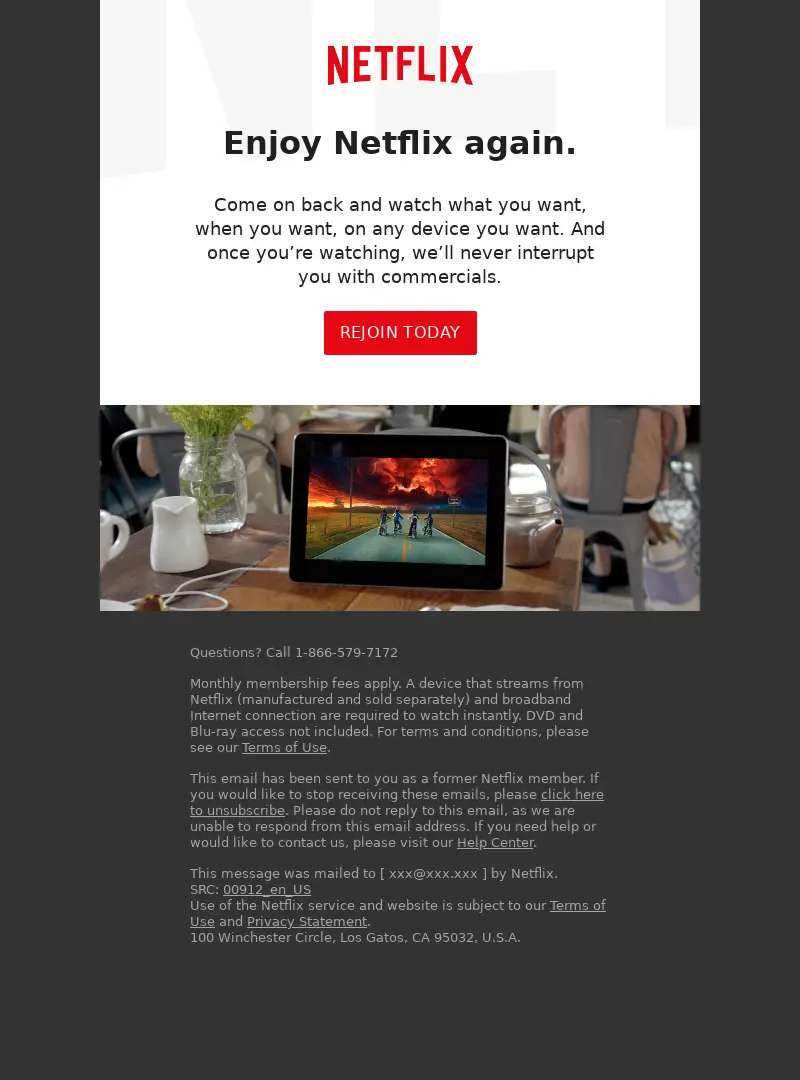
Netflix knows its audience. Instead of dangling a discount or incentive, they focus on reminding inactive subscribers what they’re missing.
And let’s be real—sometimes people just need a little nudge to come back. I’ve seen firsthand how powerful it can be to highlight benefits over discounts.
Instead of offering a deal right away, try reminding your audience why they loved your service in the first place.
For example, if you’re in the subscription business, showcase what’s new since they left. Something like, “We’ve added 100+ new shows since you last watched!” can get their attention.
If you want to make it even more personal, include tailored recommendations based on their past activity. It’s like saying, “Hey, we saved your favorites just for you.” Little touches like this make your re-engagement emails feel intentional, not generic.
YouTube TV: Urgency Meets Value
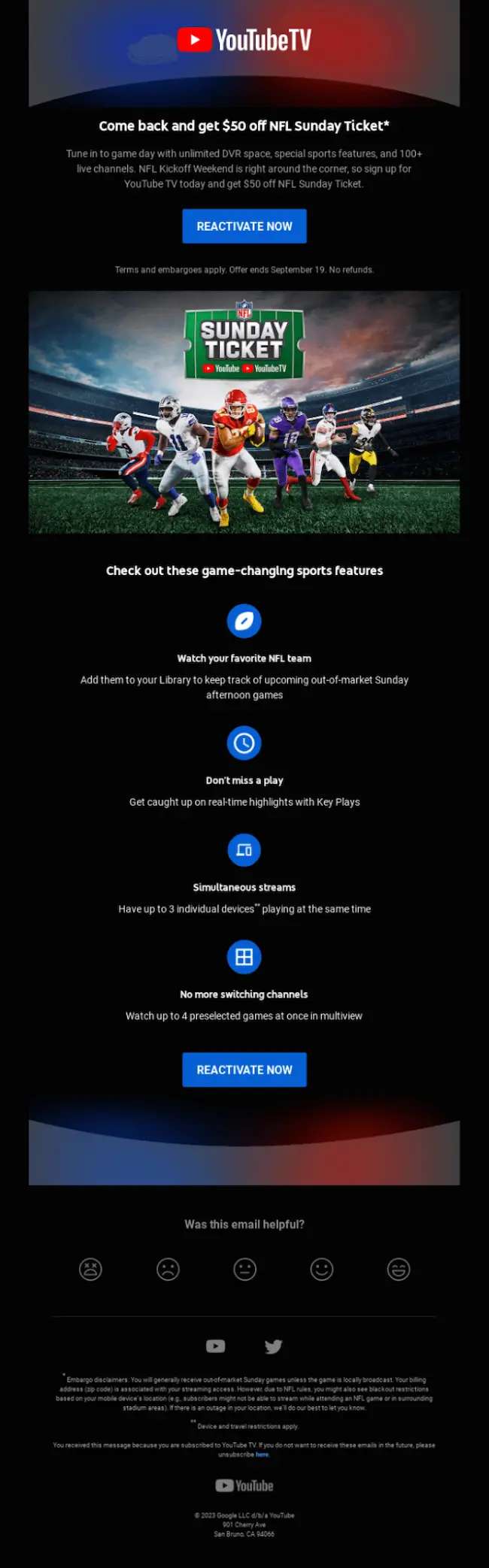
YouTube TV nails it with their re-engagement emails because they combine urgency with clear value.
They’re not just saying, “Come back, please.” Instead, they’re saying, “Here’s $50 off, and oh, by the way, NFL season is starting!” I always tell people: tie your offer to something timely. If there’s a relevant event or season that matters to your audience, use it as your hook.
One thing I’ve found helpful is to outline exactly what they’re missing.
For instance, if you’re running a special promotion, break down the features in an easy-to-digest way—like, “With YouTube TV, you get DVR, 100+ live channels, and no commercials.” If you’re clear about the benefits and make the offer time-sensitive, it’s hard for people to say no.
Product Hunt: Informative and Value-Driven
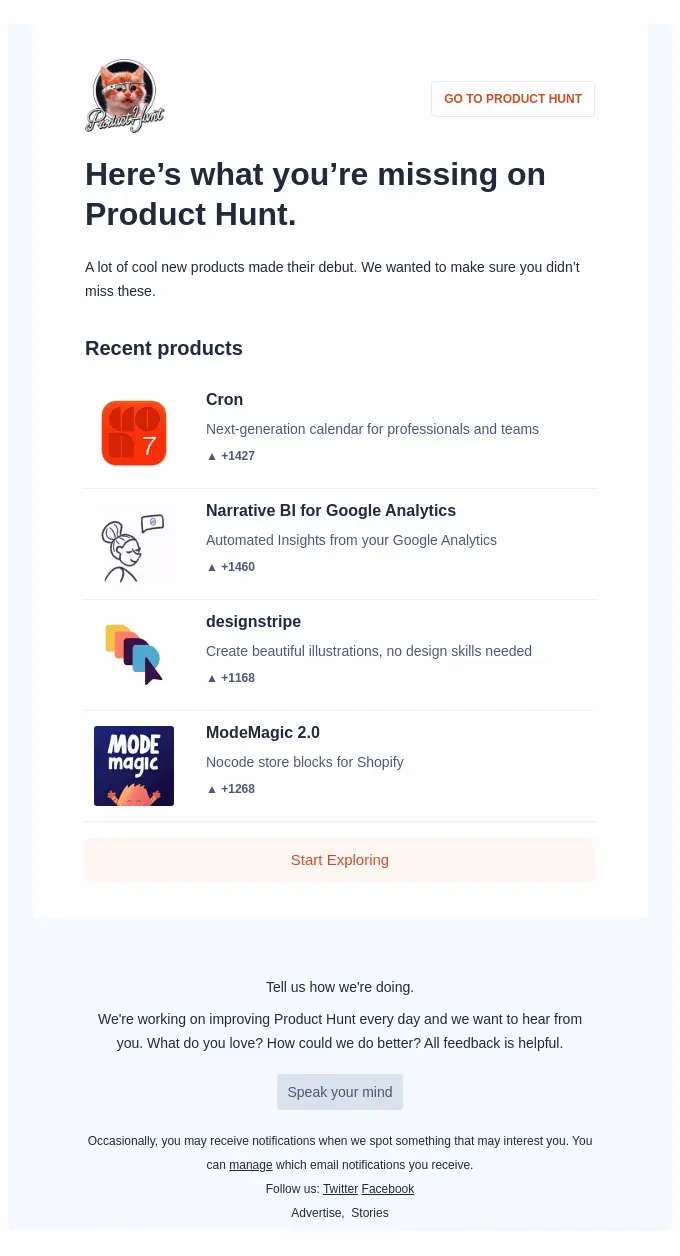
Product Hunt takes a content-first approach with their re-engagement emails, and I think it’s brilliant. Not everyone responds to discounts or flashy headlines. Sometimes, people just need a reason to re-engage—like valuable, relevant content.
If you’re not sure what to send to re-engage subscribers, start by showing them what they’re missing.
For instance, you could highlight new features, recent blog posts, or products they’d find helpful.
Say something like, “Here are the top tools you missed last month—we think you’ll love them.” When you position your re-engagement email as a helpful update rather than a sales pitch, you’re more likely to reconnect with subscribers who prefer value-driven content.
Marley Spoon: Play on Emotion and Show Improvement
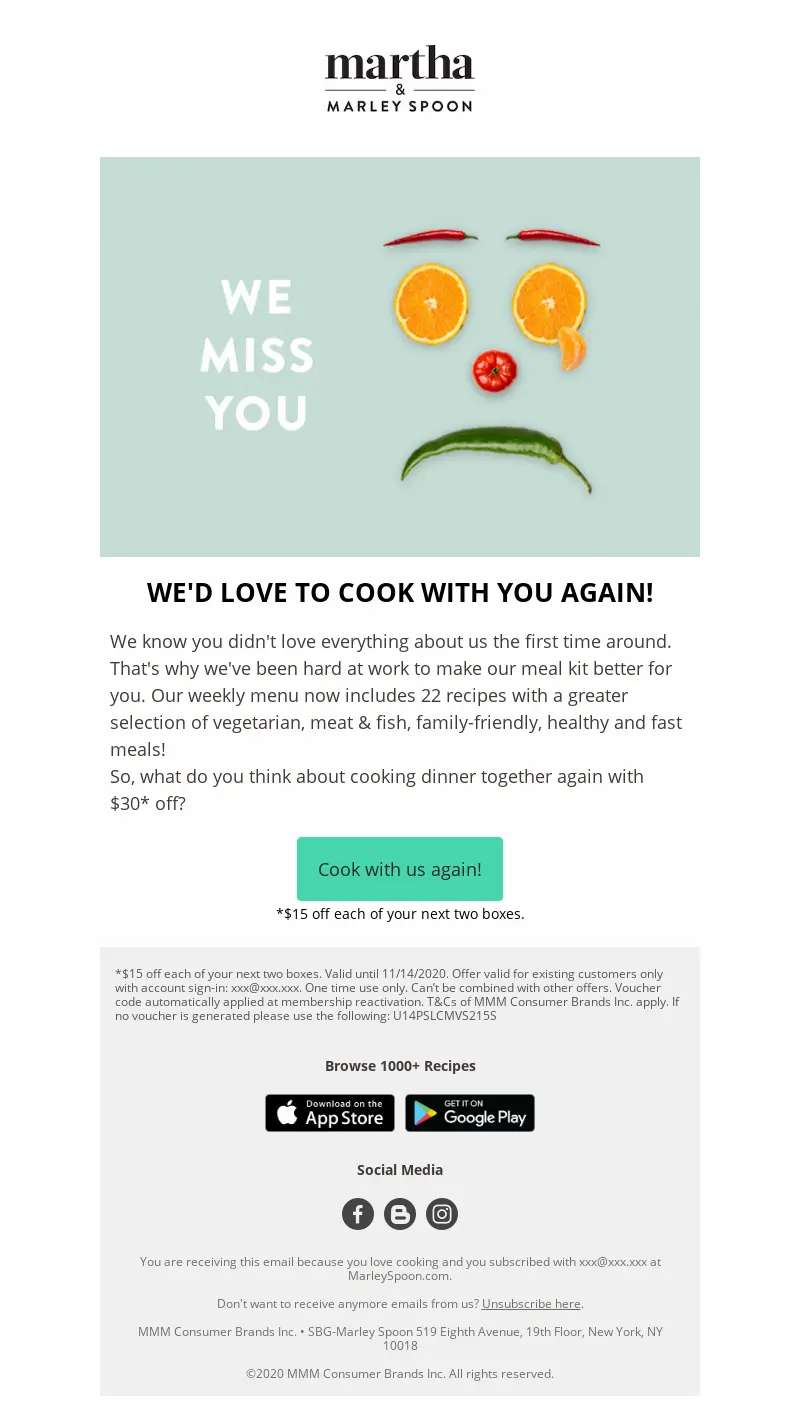
Marley Spoon’s approach to re-engagement emails feels human, and that’s what makes it work. They lead with an emotional hook—“We miss you!”—but they don’t stop there. They address why the reader might’ve left and what’s improved since then.
I always tell people: if you’ve made changes or upgrades to your product or service, call them out. It’s your chance to win back trust.
Here’s what’s worked for me: acknowledge the past and offer something to make their return worthwhile.
For example, “We’ve added 20+ new recipes, including healthier and faster meal options. Here’s $30 off to give us another try.” It’s honest, it’s direct, and it gives the reader a clear reason to come back.
The Hut: Ask for Permission, Respect Their Choice
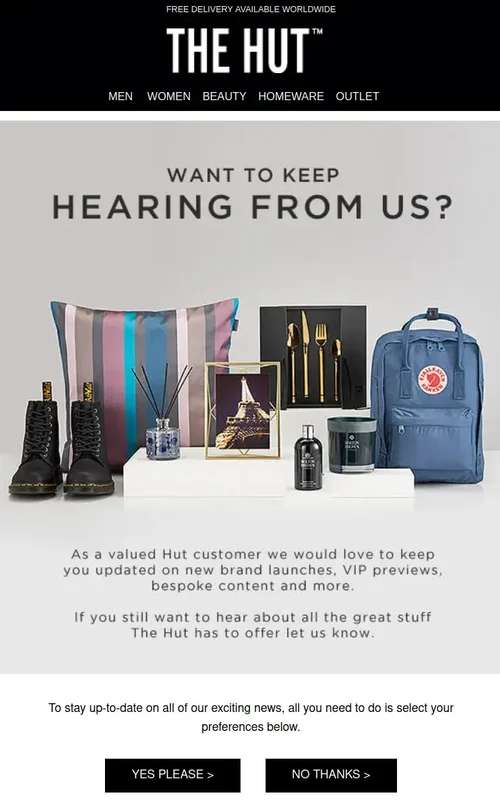
The Hut’s re-engagement email stands out because it’s straightforward and respectful.
Instead of begging subscribers to stay, they simply ask: “Do you still want to hear from us?” It’s a great approach when you’re dealing with inactive subscribers who haven’t engaged in a while.
I’ve found that sometimes, giving people the option to opt back in works better than trying to convince them to stay.
When you take this approach, make sure you also reinforce what they’ll get if they stick around.
For instance: “We’d love to keep you updated on exclusive discounts, VIP previews, and the latest products.” Adding a little incentive like “Stay connected and get a free shipping voucher!” can make the decision easier.
Plus, it helps you keep only the subscribers who genuinely want to hear from you—improving your overall sender reputation.
If there’s one thing I’ve learned about re-engagement emails, it’s that there’s no one-size-fits-all approach. Some people respond to discounts, while others prefer valuable content or simple reminders.
The key is to test different strategies, keep your tone human and conversational, and always focus on what’s in it for the reader. Trust me, a little effort to reconnect can go a long way.
Launch Your Next Re-Engagement Campaign with GoCustomer
Re-engaging an audience that’s gone quiet doesn’t have to feel like guesswork. As we’ve seen, the most successful re-engagement emails focus on value, timing, and personalization. For inspiration, exploring re-engagement email examples can provide practical insights into what works best for different audiences.
Whether it’s reminding someone what they’re missing, sharing meaningful updates, or giving them a gentle nudge, the key is to make the message relevant to the reader. Reviewing re-engagement email examples can help identify the strategies that drive results.
Now, I get it—scaling hyper-personalized outreach like this sounds great, but it’s a real challenge when you’re dealing with hundreds or thousands of subscribers. That’s something I’ve struggled with before. Crafting one email that feels like it was written just for the recipient takes time, and doing it at scale? Almost impossible.
That’s where I’ve found tools like GoCustomer really helpful. What I like about it is how it solves the scalability problem without losing that personal touch.
GoCustomer uses specialized agents—like its LinkedIn Agent—to gather insights about your audience from multiple sources.
For example, if you’ve got someone’s LinkedIn URL, it can pull their recent activity, job role, or achievements, so you can write a re-engagement email that actually feels thoughtful and intentional.
On top of that, its built-in drip campaigns and domain warm-up ensure your emails don’t end up in the spam folder—something I’ve found critical when reconnecting with inactive subscribers.
And if you’re just getting started, there’s a free forever plan to test the waters.
If you’ve been struggling to create re-engagement campaigns that scale while still feeling human, GoCustomer is worth exploring. It’s made a real difference for me in simplifying personalized outreach, and it could help you breathe life back into your email list too.
Because at the end of the day, re-engagement isn’t just about sending emails—it’s about building meaningful connections again.

Reach more customers with your cold emails
Table of Contents
In a nutshell
It's advisable to send them after a subscriber has been inactive for a specific period, such as 3 to 6 months, depending on your business cycle.
Include personalized content, compelling subject lines, special offers or discounts, and a clear call-to-action to encourage re-engagement.
Avoid generic messaging, neglecting hyper personalization, sending too many emails, and failing to provide value or incentives to the recipient.
Yes, it's best to remove subscribers who remain unresponsive to maintain a healthy email list and improve overall engagement metrics.
Absolutely. By addressing inactivity and offering value, re-engagement emails can rekindle interest and strengthen customer relationships, leading to improved retention.
Subscribe to our Newsletter!
Digital advice costs money but we send it to
your inbox for free.
Related Blogs
Time is Money, and We're About to Save You Both!
Book a quick demo of our email marketing tools and watch as we transform your leads into loyal customers.
![A loop illustration w-auto h-[70px]](/_next/image?url=%2F_next%2Fstatic%2Fmedia%2Fvector1.7738e6de.png&w=256&q=75 "GoCustomer Platform Image")

Get in touch
Subscribe to our weekly Newsletter and receive updates via email.