


Email Marketing
Published:
Email Marketing
Qasim Farooq
Share

Email marketing continues to be a heavyweight champion in the digital marketing ring, driving higher conversions and fostering long-term engagement.
However, as inboxes become increasingly crowded, catching (and keeping) your subscribers’ attention is no easy feat. That’s where A/B testing swoops in to save the day.
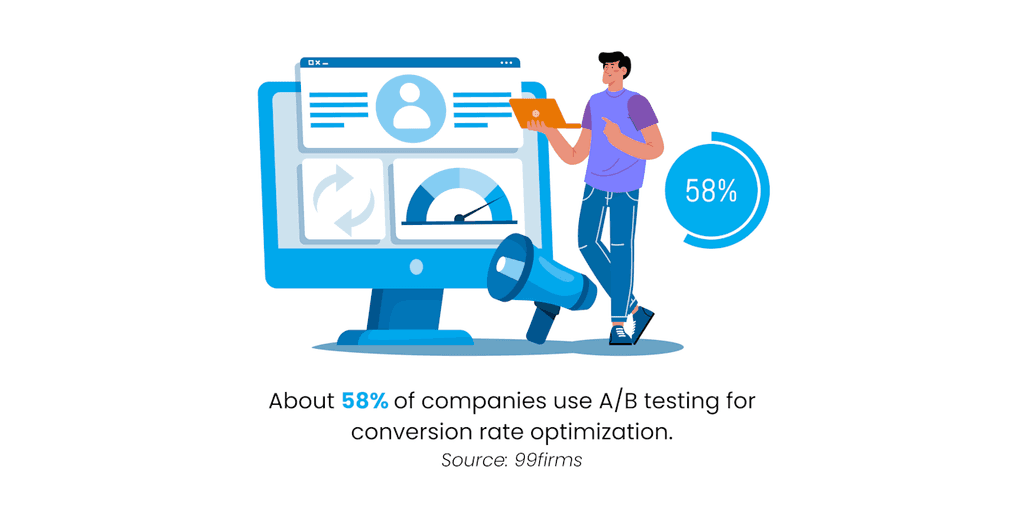
For years, marketers have relied on this method to optimize various email elements, from subject lines to call-to-action buttons (CTAs). But as we move deeper into 2025, new challenges and opportunities demand a sharper, more strategic focus on A/B testing.
In this post, we’ll explore why A/B testing is crucial in 2025, outline the steps for running a successful split test, share best practices for optimizing your campaigns, and provide examples you can put into action immediately.
So let's get started.
Why A/B Testing Will Be Crucial for Success in 2025
Consumers Are Busier (and Pickier) Than Ever
With an ever-growing number of brands competing for inbox space, it’s no longer enough to rely on guesswork. A/B testing gives you concrete data to ensure your emails resonate with your unique audience—and don’t get lost in the clutter.Hyper-Personalization Is the New Norm
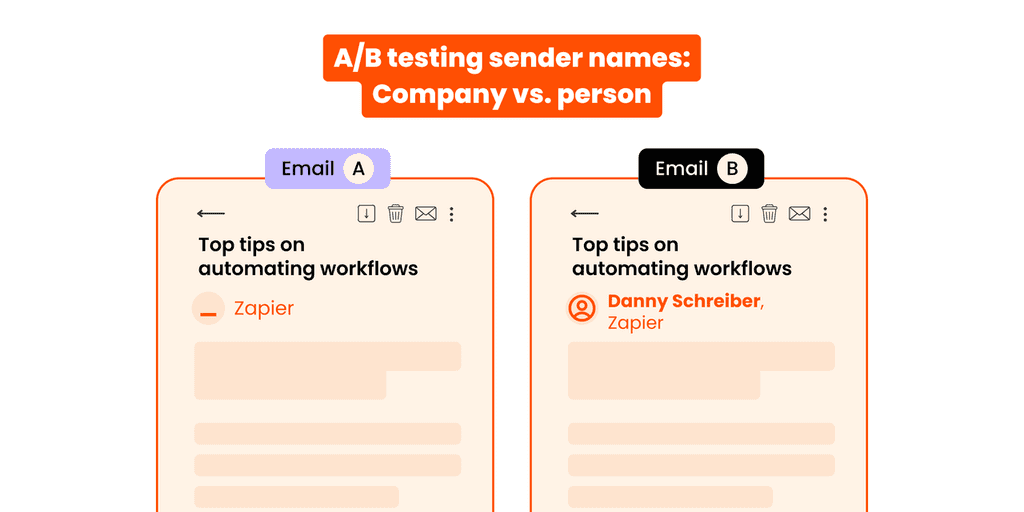
Customers in 2025 expect brands to speak their language and offer them hyper-personalized content. Split testing subject lines, personalized sender names, and dynamic content will help you understand exactly which messaging resonates with each segment of your audience.AI-Driven Insights Demand the Right Data
Marketers increasingly use AI and machine learning tools to automate and optimize campaigns. However, these tools are only as good as the data they receive. A/B testing provides the continuous flow of reliable first-party data that AI engines need to learn and improve.The High-Stakes ROI Game
Email remains one of the highest ROI channels in digital marketing. As budgets and customer acquisition costs rise, every percent increase in conversion matters. An email AB test ensures you’re maximizing your email potential to keep your brand profitable and your audience engaged.
4 Steps to A/B Test Your Emails Like a Pro
Step 1: Identify the Problem
Check Your Current Metrics: Begin by looking at your past email campaigns. Are your open rates below your industry’s average? Do your click-through rates need some love?
Spot the Bottleneck: Figure out which part of the funnel is underperforming. Is it your subject line, email body, or CTA that’s causing subscribers to drop off?
Step 2: Define a Hypothesis
Pick One Variable to Test: Maybe it’s your subject line, CTA button color, or email layout. Whichever element seems most likely to impact your desired goal is your best bet.
State Your Hypothesis: Frame it as an “If I do X, then Y will happen” statement. For example, “If I place my CTA button above the fold, my click-through rates will increase.”
Set a Measurable Goal: Determine what success looks like - e.g., a 5% increase in open rates or 10 new conversions. This keeps your testing focused.
Step 3: Test the Hypothesis
Create Two Versions (A and B): Change only the element you decided on, and keep everything else the same. This helps you isolate the impact of your test variable.
Split Your Audience Evenly: Send Version A to half of your list and Version B to the other half, or use a smaller test group if you want to preserve most of your list for the winner.
Monitor the Relevant Metrics: If you’re testing subject lines, watch open rates. If you’re experimenting with CTAs, keep an eye on click-through and conversion rates.
Step 4: Analyze the Results and Draw Conclusions
Determine the Winner: After giving your test adequate time (often 24–72 hours, depending on your audience size), check which version outperformed the other.
Roll Out the Winning Version: If there’s a clear winner, send that version to the rest of your subscribers (or implement it in future campaigns).
Revisit or Retest if Necessary: If you didn’t get a conclusive result, consider re-testing with a larger audience or adjust a different variable to see if you can pinpoint what’s causing the issue.
Best Practices for Smarter A/B Testing in Emails
A/B testing is a powerful technique, but it’s not just about hitting the “send” button on two email versions and hoping for the best. Here are some tips to get the most bang for your buck.
Test One Variable at a Time
Why It Matters for You: If you change multiple elements - subject lines, images, CTA text - all at once, you’ll never know which update caused the boost (or drop) in performance.
How to Do It: Pick one component (like the subject line) and test it against a different variation. Keep the rest of your email the same, so you can pinpoint exactly what moves the needle.
Use a Big Enough Sample Size
Why It Matters for You: If your test group is too small, your results may be skewed by just a few outliers - meaning you could roll out changes that don’t actually improve performance in the long run.
How to Do It: Use your email platform’s recommended sample size feature or a simple online calculator to ensure you’re testing with enough subscribers to get statistically reliable data.
Give Each Version Enough Time
Why It Matters for You: Some subscribers click immediately, others check their emails days later. If you and your marketing team look at your stats too soon, you might miss late openers or clicks.
How to Do It: Wait at least 24–72 hours (depending on your send volume and typical engagement habits) before declaring a winner. Keep an eye on past data to gauge the best waiting period for your audience.
Hyper-Personalize Your Tests
Why It Matters for You: In 2025, your subscribers expect you to “get” them on a deeper level. When your emails acknowledge someone’s name, interests, or behavior, it signals that you’re paying attention, not just blasting out cookie-cutter campaigns. The result? Greater trust and higher engagement.
How to Do It: Consider using a marketing solution like GoCustomer, which excels at creating highly personalized email campaigns. It gathers detailed and historical data from sources like LinkedIn and your prospect’s website to craft messages that genuinely resonate. Whether it’s referencing recent activities or specific updates, your emails will feel personal and relevant, boosting engagement rates.
For example, if GoCustomer notices that a contact just shared a LinkedIn post about sustainability, you might reference this in your next email campaign, suggesting an eco-friendly product or solution. This level of personalization makes subscribers feel like you truly understand their needs, increasing the likelihood they’ll open, click, and convert.
Keep It Relevant and Goal-Focused
Why It Matters for You: A “throw everything at the wall to see what sticks” approach can be fun, but it’s not the best use of your time or data. Aligning each test with a clear objective ensures you’re making meaningful progress.
How to Do It: Ask yourself, “Does this test help me reach my primary marketing goal?” If you’re trying to increase webinar sign-ups, for example, test the CTA copy or placement—elements that directly impact registration numbers.
Segment Your Audience Thoughtfully
Why It Matters for You: Different subscriber segments (such as new subscribers vs. longtime customers) often respond to emails in distinct ways. A one-size-fits-all strategy can lead to lukewarm results.
How to Do It: Divide your audience based on engagement levels, demographics, or past purchase behavior. Then, run your A/B tests within these specific segments to discover what truly resonates with each group.
Also Read: 9 Email Segmentation Strategies Every Email Marketer Should Know
Retest and Iterate
Why It Matters for You: Your audience’s preferences can shift over time—and what works today might not work next quarter. Continuous testing helps you stay ahead of changing trends and subscriber habits.
How to Do It: Once you identify a winning variant, implement it broadly. But don’t stop there - test new variations, keep learning, and adapt. Your subscribers will appreciate the continuous improvements.
Bonus Read: Most Effective Email Strategies for Your Business
A/B Test Examples To Boost Campaign Performance
If you’re new to A/B testing (or just need a little inspiration), here are some practical examples to help you get started. These tests can be introduced quickly and often yield big wins.
A/B Testing Email Subject Lines
Why it matters:
Your subscribers can’t engage with your email if they don’t open it in the first place. Testing your subject lines for subject line optimization is a low-effort, high-impact way to grab attention.
Quick ideas to try:
Clear vs. Mysterious: Compare straightforward lines like “Our Special Holiday Offer for You” with more enigmatic ones like “You Really Don’t Want to Miss This...”
Personalization & Emojis: Incorporate the subscriber’s name or add emojis to see if it increases open rates.
AI Generation: Use AI-powered tools (like, Mailjet’s AI Subject Line Generator) to brainstorm multiple variations quickly, and identify factors that get your emails opened.
A/B Test Images
Why it matters:
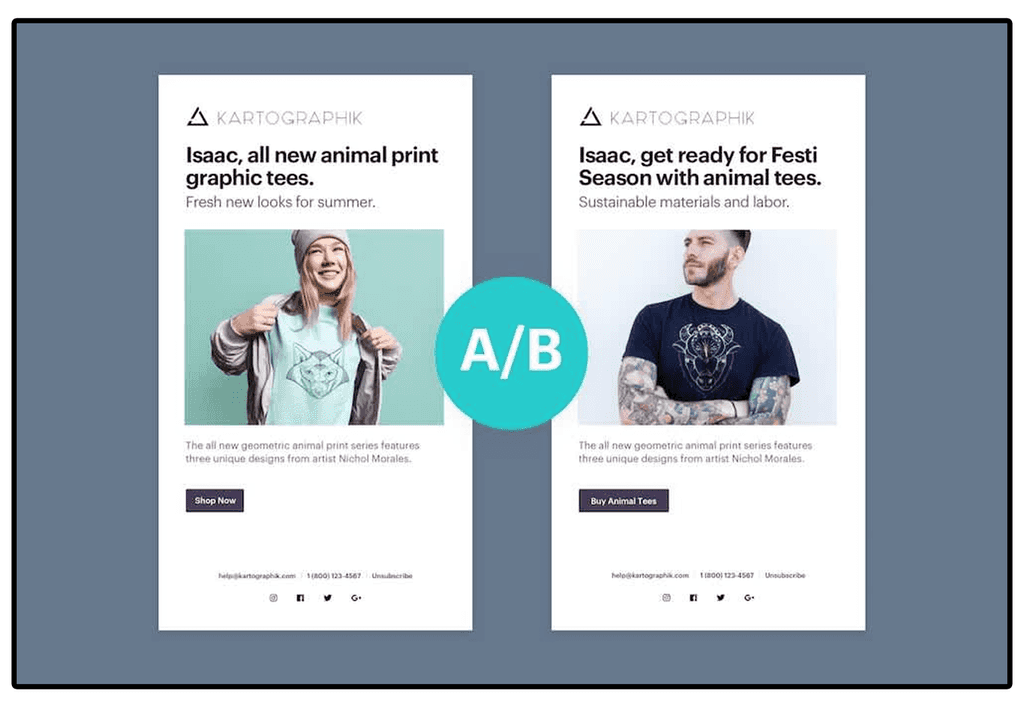
Visuals often form the first impression of your email content. Images can guide the eye, evoke emotion, or showcase products - thus contributing to email marketing success.
Quick ideas to try:
Static vs. GIFs: Test whether playful, animated GIFs capture more clicks than static banners.
Product Shots vs. Lifestyle Images: Some audiences respond better to crisp product photography, while others prefer aspirational lifestyle images.
Video Thumbnails: Experiment with clickable video previews to boost engagement.
A/B Test Copywriting
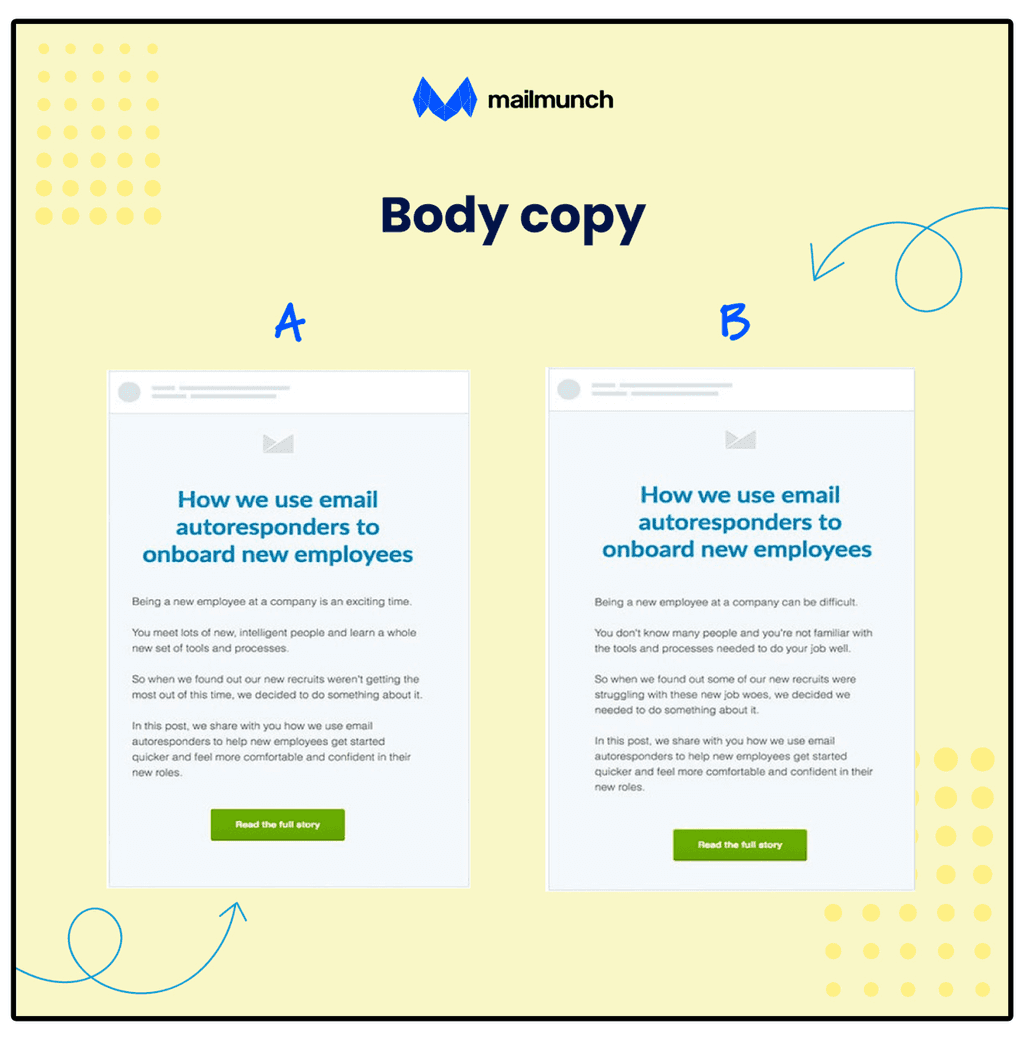
Why it matters:
Sometimes flashy visuals aren’t enough, you need persuasive text to seal the deal. Finding the right tone, style, and length can significantly influence conversions.
Quick ideas to try:
Short vs. Long Copy: Do your subscribers appreciate concise, bullet-pointed lists, or do they prefer detailed storytelling?
Focus on Benefits vs. Features: Test whether highlighting the emotional benefits of your product outperforms a straight product feature list.
Strategic Placement: Consider where your main points appear. For instance, placing vital info “above the fold” vs. weaving it into the email body.
A/B Test Calls-to-Action (CTAs)
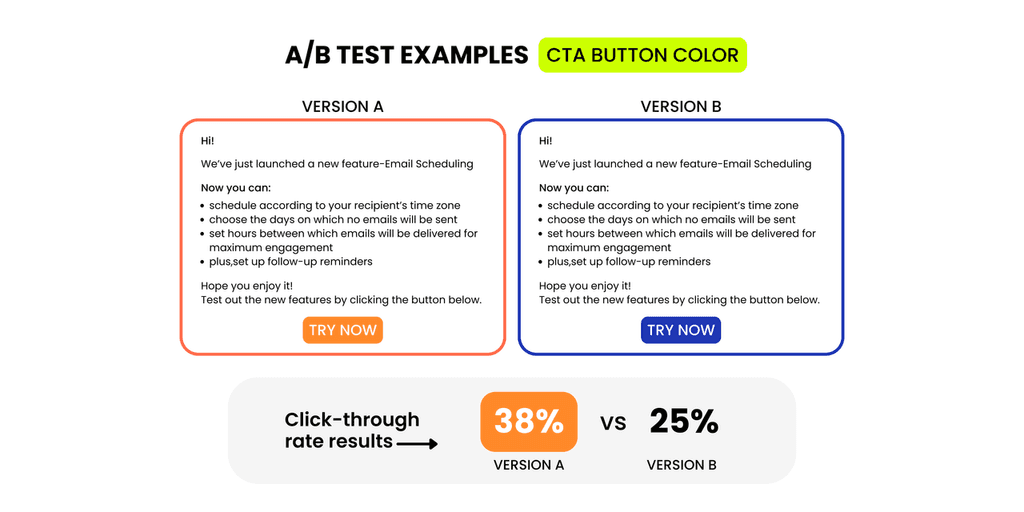
Why it matters:
Your CTA is what ultimately drives subscribers to take the next step. Small tweaks in wording, color, or placement can yield dramatic results.
Quick ideas to try:
Color & Size: Test a bright, bold CTA button against a more subtle design.
Text Variations: Compare phrases like “Buy Now” vs. “Get Yours Today” to see which motivates more clicks.
Placement: Experiment with one CTA near the top vs. multiple CTAs throughout the email for better engagement.
A/B Test Sending Time
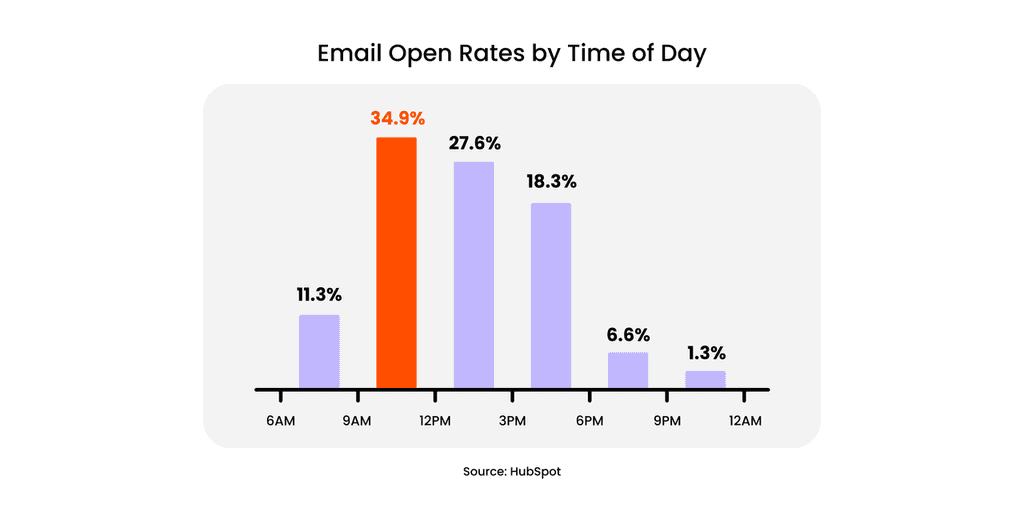
Why it matters:
Even the most polished email can miss the mark if it arrives in your subscribers’ inbox at the wrong time or day.
Quick ideas to try:
Morning vs. Evening Sends: Some subscribers open emails first thing in the morning, while others prefer after-work browsing.
Weekday vs. Weekend: Experiment with weekday sends for business audiences and weekend blasts for more casual offers.
Segmented Scheduling: Once you discover optimal times for different segments, create targeted send schedules to maximize open and click-through rates.
Real-World A/B Testing Success Story
River Island: Fine-Tuning Email Frequency and Engagement
What they did:
Set clear goals to improve customer experience and reduce email frequency without sacrificing revenue.
Used A/B testing to identify which emails truly resonated with their subscribers.
Results:
30.9% increase in revenue per email
26% increase in email open rate
12.8% decrease in unsubscribe rate
Achieved these wins despite sending 22.5% fewer total emails
Key takeaway:
River Island proves that less can be more. By testing the impact of each campaign and focusing on quality over quantity, you can boost both engagement and revenue - even as you reduce send volume.
You might like: 10 Email Marketing Blogs Every Marketer Should Follow in 2024
Conclusion
A/B testing remains one of the most powerful (and surprisingly simple) ways to refine your email marketing strategy.
By continually experimenting and fine-tuning every aspect of your email campaigns, you’ll discover the real levers that drive engagement, conversions, and ROI. From testing subject lines to personalizing your content, each step brings you closer to delivering the right message at the right time.
Remember to keep your tests focused, use a robust sample size, and give each variation enough time to shine. Embrace hyper-personalization with solutions like GoCustomer to make your emails feel uniquely tailored to each subscriber, boosting engagement even further.
Here’s to creating more effective, engaging, and profitable email campaigns in 2025 and beyond!

Reach more customers with your cold emails
Table of Contents
In a nutshell
A/B testing in email marketing is a method where you create two versions of an email (Version A and Version B) with one differing element to determine which performs better. This could involve testing different subject lines, images, CTAs, or any other component to see which variation resonates more with your audience.
A/B testing allows you to make accurate data-driven decisions, ensuring that your future email campaigns are optimized for higher open rates, click-through rates, and conversions. By systematically testing different elements, you can understand what works best for your audience, reduce guesswork, and ultimately improve your return on investment (ROI).
Start by identifying a specific goal, such as increasing open rates or boosting conversions. Choose one variable to test (e.g., subject line), create two versions of your email with that single difference, and split your audience into two equal groups to receive each version. After sending, analyze the results to determine which version performed better.
A statistically significant sample size ensures reliable results. While the exact number can vary based on your total audience and desired confidence level, a good rule of thumb is to use at least a few hundred recipients per variation. Many email platforms offer built-in sample size recommendations or you can use online calculators to determine the appropriate size for your tests.
Hyper-personalization tailors your emails to each subscriber's unique preferences, behaviors, and interests. By using detailed, valuable data to customize content—such as addressing subscribers by name, recommending products based on past purchases, or referencing recent interactions—your emails become more relevant and engaging. This leads to higher open rates, increased click-through rates, and improved conversions.

Subscribe to our Newsletter!
Digital advice costs money but we send it to
your inbox for free.
Related Blogs


Time is Money, and We're About to Save You Both!
Book a quick demo of our email marketing tools and watch as we transform your leads into loyal customers.

![A loop illustration w-auto h-[70px]](/_next/image?url=%2F_next%2Fstatic%2Fmedia%2Fvector1.7738e6de.png&w=256&q=75 "GoCustomer Platform Image")

Get in touch
Subscribe to our weekly Newsletter and receive updates via email.